Does Magnesium Timing Matter More Than People Think?
Quick Answer: Timing matters for tolerance and for whether you notice an effect, and much less for whether magnesium is absorbed at all. Taking it with food reduces digestive upset substantially. Taking it 60 to 90 minutes before bed lines up the calming effect with the sleep window. Splitting a larger dose into two smaller ones absorbs better than one large dose, because fractional absorption falls as dose size rises. And separating magnesium from high-dose calcium, zinc, or iron by a couple of hours avoids competition for the same absorption pathways.
Most people who conclude magnesium does nothing for them took it once daily, on an empty stomach, at the wrong end of the day, alongside a multivitamin.

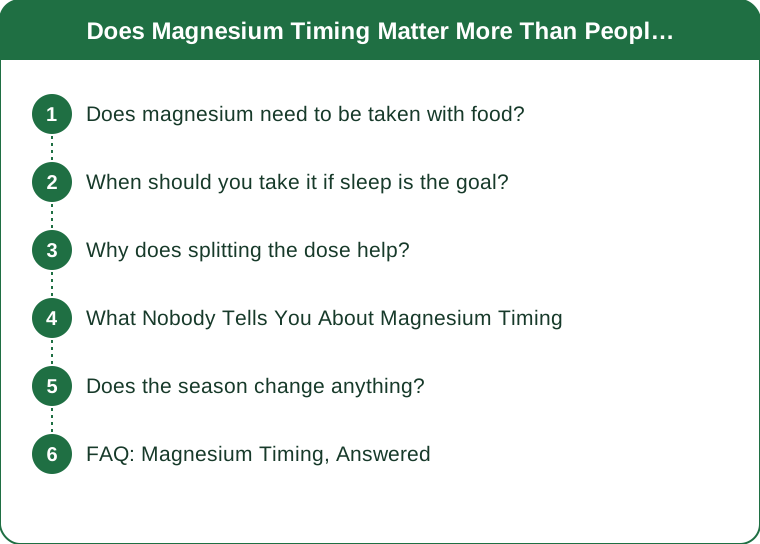
Does magnesium need to be taken with food?
For tolerance, yes, and it makes a large difference. The most common reason people abandon magnesium is digestive upset, and that upset is substantially reduced by taking it with a meal.
For absorption, the effect is modest. Magnesium is absorbed reasonably well with or without food, and the difference between the two is not large enough to explain someone getting no benefit at all.
Forms differ in how much this matters. Citrate and oxide have a strong osmotic laxative effect on an empty stomach; glycinate is much gentler and is the form most people tolerate without food.
Very high-fibre meals slightly reduce absorption, particularly high-phytate foods, though not enough to justify avoiding them.
A small snack is enough. You do not need a full meal - a few nuts or a small yogurt is sufficient to blunt the digestive effect.
And consistency beats optimisation. Taking it with the same meal daily is more useful than switching timing in search of a marginal absorption gain.
When should you take it if sleep is the goal?
Sixty to ninety minutes before bed is the usual sweet spot. That window allows absorption and the beginning of any calming effect to coincide with sleep onset rather than arriving at 3am.
Taken immediately at lights-out, some people notice nothing simply because peak effect arrives after they were already asleep or well after they were still awake trying to fall asleep.
Glycinate is the form most associated with the sleep application, partly because of the glycine component and partly because it is tolerable at bedtime without digestive consequences.
The effect is a nudge, not a sedative. Magnesium does not induce sleep the way a sleep medication does, and expecting that produces the very common conclusion that it does not work.
People with a genuine shortfall notice more. Someone already replete may reasonably feel nothing at all, which is not a failure of the supplement.
And two weeks of consistency is the minimum before judging. Single-night assessments of a mineral that acts on repletion status are close to meaningless.
Why does splitting the dose help?
Fractional absorption falls as dose rises. A smaller dose absorbs a higher percentage of itself, which means two 150 mg doses can deliver more absorbed magnesium than one 300 mg dose.
Digestive tolerance improves markedly with splitting, particularly for citrate, where a single large dose is a reliable route to an urgent bathroom trip.
A morning and evening split suits people using it for both cramping and sleep, covering the day rather than concentrating everything at night.
People taking above roughly 200 to 250 mg of elemental magnesium daily benefit most from splitting; below that the effect is minor.
Check the elemental content on the label, not the compound weight. A 500 mg magnesium glycinate capsule may contain only around 50 to 100 mg of elemental magnesium, and this discrepancy is behind an enormous number of unintentional under-doses.
And that label confusion is the most common reason someone thinks they took a lot and felt nothing. Read the elemental figure before concluding a form does not work.

What Nobody Tells You About Magnesium Timing
High-dose calcium, zinc, and iron compete with magnesium for absorption, so taking a multivitamin and a magnesium supplement together undercuts both. Two hours of separation resolves it.
Coffee and alcohol both increase magnesium excretion, which means a heavy-coffee, regular-drinking week has a higher requirement than a quiet one - and that variation alone can explain why it seems to work some months and not others.
Training raises requirement through sweat losses, so athletes in hot conditions need more, and often more than they think.
Some blood pressure and diabetes medications, and some antibiotics, interact with magnesium timing - tetracycline and quinolone antibiotics in particular should be separated by several hours. Check with a pharmacist rather than guessing.
Proton pump inhibitors reduce magnesium absorption over long-term use, which is a well-documented interaction and one worth raising with a doctor if you take them chronically.
And blood magnesium tests are close to useless for detecting a shortfall, because the body defends serum levels by pulling from bone and tissue. A normal serum result does not rule out depletion, which is why symptoms and response usually guide the decision instead. This is general information, not medical advice.
Does the season change anything?
Sweat losses fall as the weather cools, so the summer requirement drops through autumn - some people find a dose that was right in July is slightly too much in October.
Sleep timing shifts with the light, and if you move your bedtime earlier as evenings darken, the pre-bed dose should move with it rather than staying at a fixed clock time.
Autumn training changes composition for many people - more indoor lifting, less long outdoor endurance - which changes both sweat losses and cramping patterns.
Dietary magnesium changes seasonally too. Summer salads, nuts, and leafy greens deliver more than a winter diet heavier in refined carbohydrates, so the supplement gap widens as the year goes on.
Alcohol intake typically rises through the holiday season, and alcohol is a genuine magnesium drain.
And that seasonal drift is why people so often report a supplement working, then not, then working again. The variable is usually the background requirement rather than the product.
FAQ: Magnesium Timing, Answered
Morning or night?
Night if the goal is sleep or evening cramps; split morning and night if the dose is above roughly 200 mg elemental or the goal is general repletion.
With food or without?
With food for citrate and oxide, which are much harsher on an empty stomach. Glycinate is usually fine either way.
How long before bed?
Sixty to ninety minutes. Taking it as you turn the light off often means the effect arrives after you are already asleep.
Can I take it with my multivitamin?
Better not to, if the multivitamin has high-dose calcium, zinc, or iron. Separate them by about two hours.
How long before I know if it works?
Two to four weeks of consistent daily use. Single-night assessments tell you nothing.
Should I get my magnesium level tested?
Serum magnesium rarely detects a functional shortfall because the body defends blood levels from tissue stores. Discuss symptoms with a doctor rather than relying on a standard blood panel. This is general information, not medical advice.
TL;DR:
- Timing mainly affects tolerance and whether you notice an effect - not whether magnesium is absorbed at all.
- Take citrate and oxide with food; glycinate is gentle enough for an empty stomach and is the usual choice for sleep.
- Sixty to ninety minutes before bed lines up the effect with sleep onset; at lights-out is often too late to notice.
- Split doses above roughly 200 mg elemental - smaller doses absorb a higher percentage and are far easier on digestion.
- Separate from high-dose calcium, zinc, or iron by two hours, and check the elemental figure on the label rather than the compound weight.
Coffee, alcohol, sweat, and season all shift your requirement, which is why the same dose seems to work some months and not others. This is general information, not medical advice.
Keep Reading
This article is for general informational purposes only and is not medical advice. Always consult a qualified health professional for guidance specific to you.