Why Different Magnesium Forms Are Not Interchangeable
Quick Answer: The differences come down to how much elemental magnesium each form contains and how well it is absorbed. Oxide is high in elemental magnesium and poorly absorbed, which is why it is effective as a laxative and less useful for raising magnesium status. Citrate is reasonably well absorbed and also has a laxative effect at higher doses. Glycinate is well tolerated and commonly chosen when gastrointestinal effects are a problem. Threonate is marketed for cognitive effects on much thinner human evidence.
Match the form to the reason you are taking it, and talk to a doctor or pharmacist first, especially if you take other medication.

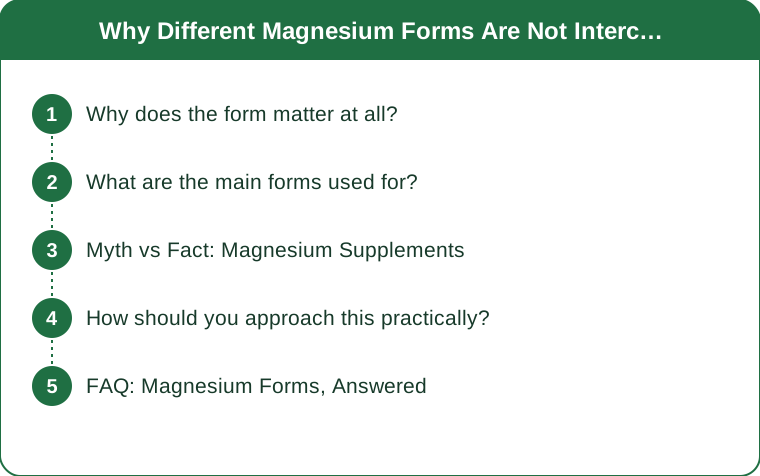
Why does the form matter at all?
Two separate variables.
Elemental magnesium content. A 500mg magnesium oxide tablet does not contain 500mg of magnesium. It contains 500mg of the compound, of which roughly 60 percent is elemental magnesium. Magnesium glycinate is a much larger molecule, so the same tablet weight contains considerably less elemental magnesium, often around 14 percent. Labels vary in whether they state the compound weight or the elemental weight, which is a common source of confusion.
Absorption. Organic salts such as citrate, lactate and glycinate are generally better absorbed than the inorganic oxide form. Studies comparing absorption consistently find oxide performs poorly relative to the organic salts, though the exact magnitude varies between studies.
Those two variables pull in opposite directions, which is why the comparison is not simple. Oxide has high elemental content and poor absorption; glycinate has lower elemental content and better absorption and tolerability.
The third practical variable is gastrointestinal effect. Poorly absorbed magnesium stays in the gut and draws water in osmotically, which is precisely how magnesium-based laxatives work. So the forms that absorb least are the ones most likely to cause loose stools, and that is a feature or a side effect depending on what you wanted.
And a point that matters: magnesium status is difficult to assess. Serum magnesium is a poor indicator of total body stores because most magnesium is intracellular and in bone, so a normal blood test does not rule out inadequacy. This is a genuine limitation and a reason to discuss it with a doctor rather than self-diagnosing.
What are the main forms used for?
Magnesium oxide. High elemental content, poor absorption, strong osmotic effect. Widely used for constipation and for heartburn as an antacid. Cheap. Less suitable if the goal is raising magnesium status.
Magnesium citrate. Well absorbed relative to oxide, widely available, moderate cost. Also has a laxative effect at higher doses, which is why it is used in bowel preparation. A common general-purpose choice.
Magnesium glycinate, sometimes called bisglycinate. Magnesium bound to the amino acid glycine. Generally well tolerated with less gastrointestinal effect, which is the main reason it is chosen. Frequently marketed for sleep and relaxation, partly on the basis of glycine’s own properties; the human evidence for a specific sleep benefit is limited.
Magnesium malate, lactate, taurate. Various organic salts, generally well tolerated, marketed for different purposes with varying and often thin evidence.
Magnesium L-threonate. Marketed for cognitive benefit on the basis that it raises brain magnesium in animal studies. Human evidence is limited and preliminary, and it is considerably more expensive.
Magnesium sulphate, as Epsom salts. Used in baths. Absorption through intact skin is not well demonstrated, and the evidence for transdermal magnesium is weak. A warm bath is pleasant regardless.
Topical magnesium oils and sprays are in a similar position: popular, and not well supported by absorption data.

Myth vs Fact: Magnesium Supplements
Myth: Most people are deficient in magnesium. Fact: Intakes below recommended levels are common in many populations, and clinically significant deficiency is much less common in otherwise healthy people. Low intake and deficiency are not the same thing.
Myth: A blood test will tell you if you need it. Fact: Serum magnesium reflects only a small fraction of body stores and can be normal despite inadequate status. It is still worth testing when a doctor thinks it is relevant, and it is not a definitive answer on its own.
Myth: More is better. Fact: Excess supplemental magnesium causes diarrhoea, and in people with impaired kidney function it can accumulate to dangerous levels. Upper limits for supplemental magnesium exist and are worth respecting.
Myth: Glycinate is objectively the best form. Fact: It is well tolerated, which makes it a sensible default for many people. Best depends entirely on the purpose, and for constipation oxide or citrate is more useful.
Myth: Magnesium cures cramps. Fact: Evidence for magnesium supplementation reducing exercise-associated or nocturnal cramps is mixed and generally unimpressive in trials, despite the popularity of the idea.
Myth: Food sources are not enough. Fact: Nuts, seeds, legumes, whole grains and leafy greens are good sources, and dietary intake is the first place to look before supplementing.
How should you approach this practically?
Talk to a doctor or pharmacist first, particularly about interactions. Magnesium can interfere with the absorption of several drug classes, including some antibiotics and bisphosphonates, and anyone with kidney impairment should not supplement without medical guidance because the kidneys clear magnesium.
Look at diet first. Pumpkin seeds, almonds, spinach, black beans, whole grains and dark chocolate are all significant sources. Increasing these has other benefits and no interaction risk.
If you supplement, read the elemental magnesium figure, not the compound weight. Two products at the same milligram number can differ several-fold in the magnesium they deliver.
Match form to purpose. Constipation, oxide or citrate. General supplementation with sensitive digestion, glycinate. Anything else, be sceptical of the specific marketing claim and check what the evidence actually supports.
Start at a lower dose and split it. Divided doses through the day are generally better tolerated and better absorbed than one large dose.
Take it consistently rather than occasionally. If you are addressing intake, it is a daily thing, not an as-needed one.
Watch for the obvious side effect. Loose stools are the usual sign that either the dose or the form needs changing.
And be realistic about what to expect. If your intake was adequate, supplementing is unlikely to produce a noticeable effect, and that is not a failure of the product.
This is general information, not medical advice. Supplements can interact with medication and are not appropriate for everyone; discuss them with a doctor or pharmacist.
FAQ: Magnesium Forms, Answered
Which form is best absorbed?
Organic salts such as citrate, lactate and glycinate are generally better absorbed than oxide. Exact figures vary between studies.
Why does magnesium give me diarrhoea?
Unabsorbed magnesium draws water into the gut osmotically. Switching to a better-absorbed form or lowering the dose usually resolves it.
Should I take it at night?
Many people do, and the evidence that timing matters for sleep is limited. Consistency matters more than timing.
Do Epsom salt baths work?
Evidence for meaningful absorption through intact skin is weak. The bath is still relaxing.
Can I get enough from food?
Often yes. Nuts, seeds, legumes, whole grains and leafy greens are good sources and worth prioritising first.
Is it safe to take long term?
For most healthy adults at sensible doses, generally yes, and it should be discussed with a doctor, especially with kidney conditions or regular medication.
TL;DR:
- Forms differ in elemental magnesium content and in absorption, and those two pull in opposite directions.
- Oxide is cheap, poorly absorbed and effective as a laxative; citrate is better absorbed and also laxative at higher doses.
- Glycinate is chosen mainly for tolerability; threonate is expensive with limited human evidence.
- Read the elemental magnesium figure, not the compound weight.
- Serum magnesium is a poor indicator of total body status.
- Food sources first, then talk to a doctor or pharmacist about form, dose and interactions.
Match the form to the reason, and check interactions before you start.
Keep Reading
This article is for general informational purposes only and is not medical advice. Always consult a qualified health professional for guidance specific to you.