Can You Get Enough Magnesium From Water? Questions Answered
Quick Answer: Yes, water contains magnesium, and in hard-water areas or from high-mineral bottled waters it can supply 10 to 20 percent of your daily requirement — occasionally more. Magnesium in water is also absorbed well, comparably to or better than from food. But the range is enormous: soft tap water and most bottled waters contain almost none, so whether water counts for you depends entirely on which water you drink.
Most magnesium advice assumes water is a neutral vehicle. Just something you swallow the supplement with.
Then you look at the label on a bottle of French mineral water and it says 110 milligrams per litre, and you realise that is a third of a daily requirement in something you were treating as nothing.

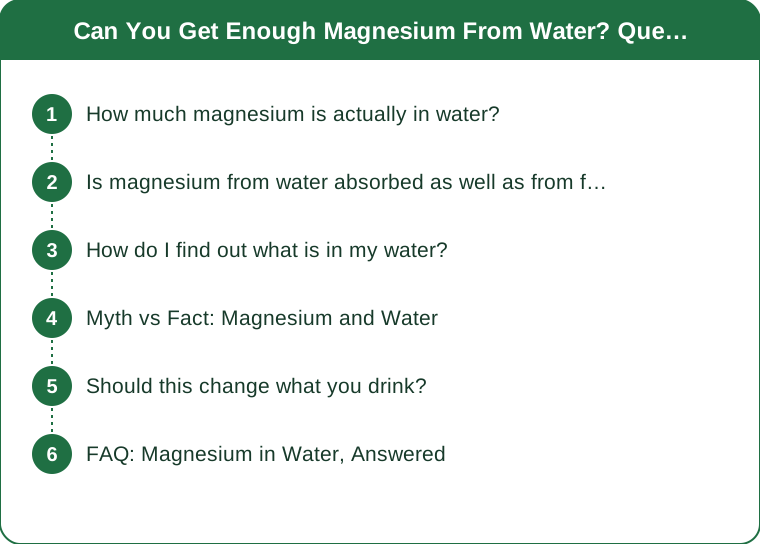
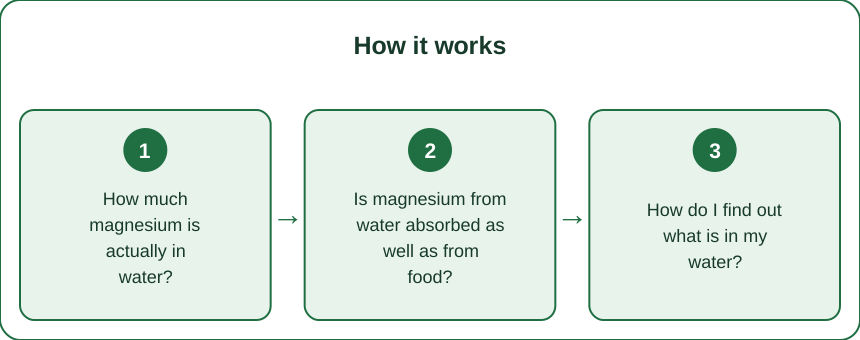
How much magnesium is actually in water?
Anywhere from under 1 milligram per litre to over 100, which is one of the widest ranges in the whole diet.
Soft tap water: 1 to 10 mg per litre. Areas supplied from upland reservoirs and granite catchments — much of Scotland, Wales, the Pacific Northwest, Scandinavia — sit at the bottom of this range. Two litres a day contributes essentially nothing.
Hard tap water: 20 to 50 mg per litre. Chalk and limestone regions supply this. Two litres a day gives you 40 to 100 mg, which against a requirement of 310 to 420 mg is a genuinely meaningful 10 to 25 percent.
Most bottled still water: 1 to 20 mg per litre. Many popular brands are low-mineral by design, because it tastes cleaner. Check the label rather than assuming.
High-mineral waters: 50 to 130 mg per litre. Certain European mineral waters sit here, and they are the outlier case where water becomes a primary source rather than a rounding error.
The practical point: you cannot guess. Two people drinking the same volume of water in different postcodes can differ by 100 mg of magnesium a day, and neither of them knows it.
Is magnesium from water absorbed as well as from food?
Yes, and by some measures better.
Magnesium in water exists as free ions already dissolved — no digestion required to liberate it. Studies on absorption from mineral water report bioavailability broadly comparable to or slightly higher than from food, with figures around 45 to 55 percent depending on the study and the water.
Two additional factors help. Water is usually consumed on an empty or near-empty stomach, away from the compounds that inhibit magnesium absorption — phytates in whole grains, high doses of calcium, some fibre. And it arrives in small doses spread across the day, which suits magnesium absorption well, since the fraction absorbed falls as the single dose rises.
That second point is genuinely underrated. A 400 mg supplement is absorbed less efficiently, proportionally, than eight sips of mineral water totalling 100 mg. Steady low-dose delivery is the pattern the gut handles best, and drinking water throughout the day is exactly that pattern.
It is also the reason water rarely causes the loose stools associated with magnesium supplements. The dose per occasion never gets high enough.
How do I find out what is in my water?
Your water supplier publishes it, and bottled water prints it on the label.
For tap water: Search for your water company plus water quality report and your postcode. Suppliers are required to publish a full mineral analysis, and magnesium is listed, usually in mg/l. Some report hardness as calcium carbonate equivalent instead, which is less directly useful but still tells you the general picture — the harder the water, the more magnesium.
For bottled water: The mineral composition is printed on the label, usually in small type on the back. Look for Mg or Magnesium in mg/l. This varies enormously between brands from the same country, so brand loyalty is doing more than you think either way.
A rough proxy: limescale. If your kettle furs up quickly and your shower screen spots badly, you live in a hard-water area and your tap water is contributing real magnesium. If your kettle stays clean and soap lathers instantly, it is not.
One caution: filters remove it. Standard jug filters and reverse osmosis systems strip magnesium along with everything else. If you live in a hard-water area and filter everything you drink, you have removed a source you did not know you had.

Myth vs Fact: Magnesium and Water
Myth: Hard water is bad for you. Fact: It is bad for kettles and it tastes different. For health, the epidemiological picture actually leans mildly positive — several studies have found associations between water hardness and lower cardiovascular mortality, with magnesium the most commonly proposed explanation. The evidence is observational and far from conclusive, but the popular assumption that hard water is a health negative is not supported.
Myth: Adding a pinch of salt to water adds magnesium. Fact: Table salt is sodium chloride and contains none. Unrefined sea salt and pink salt contain trace magnesium, but genuinely trace — you would need an unsafe quantity of salt to get a meaningful dose.
Myth: Alkaline or ionised water is a good magnesium source. Fact: Depends entirely on the source water, not on the alkalinity. Some ionised waters are high in magnesium, others are not; the pH claim tells you nothing about mineral content.
Myth: If your water is hard, you do not need to think about magnesium. Fact: Even at the high end, water supplies perhaps a quarter of the requirement. It is a useful contribution rather than a solution, and food remains the main event.
Myth: Boiling water removes the magnesium. Fact: Boiling precipitates some calcium and magnesium as limescale, so yes, slightly — which is part of why the kettle furs up. Most remains in the water.
Should this change what you drink?
Only mildly, and only if you already have a reason to care about magnesium.
If you are supplementing and it is working, change nothing. Water is not going to replace a supplement, and adding a variable you cannot control well makes it harder to tell what is doing what.
If you are trying a food-first approach, mineral water is a legitimate and easy addition. Swapping one litre a day of low-mineral water for a high-magnesium mineral water adds roughly 100 mg with no effort, no pills, and no digestive side effects. That is a meaningful fraction of the gap most people have.
If you train hard or sweat heavily, this is more relevant. Magnesium is lost in sweat, requirements rise, and a mineral water that also supplies sodium and calcium covers several bases at once.
If you filter hard tap water, consider whether you need to. Filtering for taste or chlorine is reasonable; filtering water that is already delivering 40 mg of magnesium a day has a cost you may not have priced in.
The honest summary: water is a real but secondary source. It is worth knowing your number, worth choosing a better bottled water if you buy bottled anyway, and not worth restructuring your life around.
FAQ: Magnesium in Water, Answered
Does sparkling mineral water have more magnesium than still?
Not because it is sparkling — the carbonation is unrelated. But many of the naturally high-mineral waters happen to be sparkling, so the correlation exists in the shops even though there is no causal link. Read the label.
Can I get too much magnesium from water?
Essentially no. Even at 130 mg per litre, you would need to drink an implausible volume before magnesium became the problem, and water intake itself would become the limiting concern first. Excess magnesium from food and water is excreted by healthy kidneys without difficulty.
Does water softener change the magnesium content?
Yes, substantially. Ion-exchange softeners replace calcium and magnesium with sodium. Softened water has very little magnesium and more sodium, which is why many installations leave one kitchen tap unsoftened for drinking.
Should I choose bottled water based on magnesium?
If you already buy bottled water, checking the magnesium number costs nothing and the difference between brands is large. If you drink tap water, buying bottled specifically for the magnesium is an expensive way to get something a supplement provides for pennies.
TL;DR:
- Water magnesium ranges from under 1 to over 130 mg per litre, so whether it counts depends entirely on your water.
- Absorption is good — comparable to or better than food — helped by small doses spread across the day.
- Hard tap water can supply 10 to 25 percent of the daily requirement; soft water and most filtered water supply almost none.
- Check your supplier’s water quality report or the bottle label, and remember that jug filters and softeners strip it out.
Look up your water company’s report once. It takes two minutes and it either adds a source you did not know you had or rules one out permanently. This is general information, not medical advice.
Keep Reading
This article is for general informational purposes only and is not medical advice. Always consult a qualified health professional for guidance specific to you.