Can You Actually Take Too Much Magnesium? The Real Signs of Overdoing It
Quick Answer: Yes, it’s possible to take too much magnesium, though it’s rarely dangerous for someone with healthy kidney function — the first and most common sign of overdoing it is gastrointestinal (loose stools, cramping, nausea), which typically shows up well before magnesium reaches genuinely concerning levels, and there’s a published tolerable upper intake level for supplemental magnesium specifically, separate from food-based magnesium.
Magnesium’s reputation as basically impossible to overdo isn’t entirely accurate — it’s more that the body gives a pretty clear, uncomfortable warning sign long before things get seriously concerning.

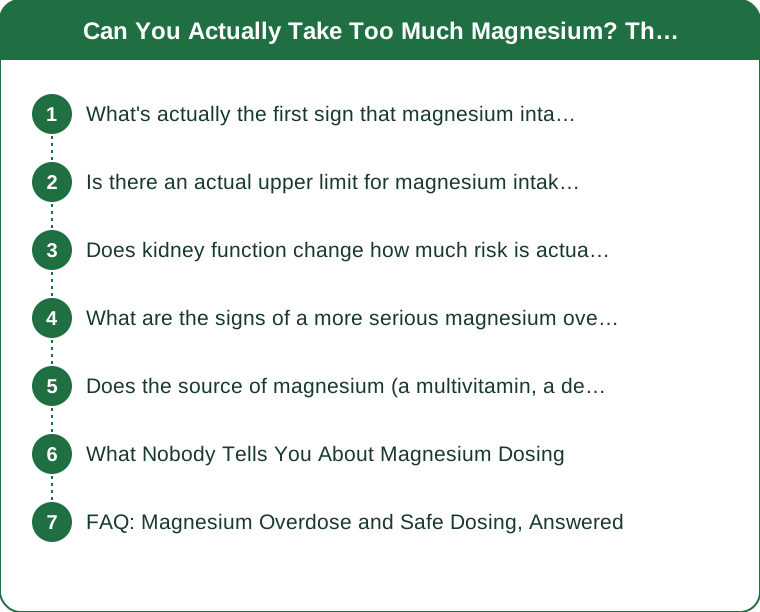
What’s actually the first sign that magnesium intake has gone too high?
For the vast majority of people, the first and most common warning sign is gastrointestinal: loose stools, stomach cramping, or nausea, since excess magnesium that isn’t absorbed draws water into the intestines. This is uncomfortable rather than dangerous for most healthy people, and it’s the body’s built-in early warning system — it tends to show up well before magnesium reaches a level that would cause more serious effects.
This GI response is actually the same mechanism behind magnesium citrate being used deliberately as a laxative at higher doses in some medical and over-the-counter contexts — the discomfort isn’t a malfunction, it’s the exact same osmotic effect simply happening unintentionally at a dose that wasn’t meant to trigger it. Recognizing this connection can actually be reassuring: the body isn’t reacting in some unpredictable or alarming way, it’s responding exactly as the underlying chemistry would predict once intake crosses a certain threshold for that individual. That threshold also varies noticeably from person to person, which is part of why two people taking the exact same dose of the exact same product can have a genuinely different experience with GI tolerance.
Is there an actual upper limit for magnesium intake, or is it truly unlimited from a safety standpoint?
There is a published tolerable upper intake level specifically for supplemental magnesium (not counting magnesium naturally occurring in food, which the body regulates more effectively) — commonly cited around 350mg per day for most adults from supplements alone, though this can vary by source and individual health status. Food-based magnesium essentially never reaches dangerous levels on its own, since the body is efficient at regulating absorption from dietary sources specifically.
This distinction between food and supplement sources surprises a lot of people, since the instinct is to think of “magnesium” as one single number to track, when in practice the source matters as much as the total amount. Someone eating a magnesium-rich diet (nuts, leafy greens, whole grains) rarely needs to worry about this upper limit at all, since it specifically applies to the concentrated, isolated form found in supplements.
Does kidney function change how much risk is actually involved?
Significantly — healthy kidneys are effective at clearing excess magnesium through urine, which is a major reason mild-to-moderate over-supplementation mostly just causes GI discomfort rather than a genuinely dangerous buildup. People with impaired kidney function have meaningfully reduced ability to clear excess magnesium, which raises real risk of a more serious buildup (hypermagnesemia) — this population needs to be notably more cautious with magnesium supplementation and should consult a doctor before starting.

What are the signs of a more serious magnesium overdose, beyond typical GI discomfort?
Beyond the common GI symptoms, more serious signs of hypermagnesemia can include unusual fatigue, muscle weakness, irregular heartbeat, and low blood pressure — these are much less common and generally require either significantly high intake, impaired kidney function, or both to occur. Any of these more serious symptoms warrant prompt medical attention rather than waiting them out.
It’s worth emphasizing how uncommon this more serious outcome actually is in someone with normal kidney function — the vast majority of magnesium overdose reports in clinical literature involve either intravenous magnesium administered in a medical setting, significant kidney impairment, or a substantial excess intake well beyond typical over-the-counter supplement dosing, rather than someone simply taking a few too many magnesium capsules from a bottle at home.
Does the source of magnesium (a multivitamin, a dedicated magnesium supplement, and an antacid) all count toward the same daily total?
Yes, and this is one of the more common ways someone accidentally exceeds the supplemental upper limit without realizing it — magnesium shows up in more products than most people expect, including some antacids, laxatives, and multivitamins, in addition to a dedicated magnesium supplement taken specifically for sleep or muscle cramps. Adding up magnesium content across every supplement and over-the-counter product taken regularly, rather than just checking the one bottle labeled “magnesium,” gives a more accurate picture of actual total daily intake.
This matters most for anyone taking multiple supplements or medications simultaneously, since it’s fairly easy to unknowingly stack several smaller magnesium sources into a total that exceeds the recommended supplemental limit, even though no single product looks like it’s providing an excessive dose on its own. A quick label check across everything in a supplement drawer, done once and revisited whenever a new product gets added, is a simple habit that catches this kind of accidental stacking before it becomes an actual issue.
What Nobody Tells You About Magnesium Dosing
Different magnesium forms have meaningfully different GI tolerability at the same dose — magnesium citrate and oxide tend to cause loose stools at lower doses than magnesium glycinate, which is generally gentler on the digestive system. Someone who assumes they can’t tolerate magnesium supplementation at all based on one form’s side effects often finds a different form works fine at the same or even a higher dose.
FAQ: Magnesium Overdose and Safe Dosing, Answered
Is it safe to take magnesium every day long-term at a moderate dose?
For most healthy adults, daily use within recommended supplemental limits (generally up to around 350mg from supplements) is considered safe long-term, though checking with a doctor is reasonable for anyone on medications that interact with magnesium. Taking it alongside a meal, rather than on an empty stomach, also tends to slow absorption and reduce the chance of GI symptoms at a given dose.
Do magnesium-rich foods carry the same overdose risk as supplements?
No — dietary magnesium from food sources essentially never reaches concerning levels on its own, since the body regulates absorption from food more tightly than it does from concentrated supplement doses.
What should someone do if they suspect they’ve taken too much magnesium?
Mild GI symptoms usually resolve by stopping or reducing the dose, but more serious symptoms like irregular heartbeat, significant weakness, or very low blood pressure warrant contacting a doctor or poison control promptly. This is general information, not medical advice.
TL;DR:
- GI discomfort (loose stools, cramping) is the first and most common sign of too much magnesium
- A published upper limit exists for supplemental magnesium specifically, separate from food sources
- Healthy kidneys clear excess magnesium well; impaired kidney function raises real risk significantly
- Different magnesium forms have different GI tolerability at the same dose
Magnesium isn’t a supplement with zero upper limit — it just tends to announce when it’s gone too far well before things get genuinely serious. This is general information, not medical advice.
Keep Reading
This article is for general informational purposes only and is not medical advice. Always consult a qualified health professional for guidance specific to you.