How Long Should Magnesium Take to Work?
Quick Answer: It depends on which effect you are waiting for. Bowel effects are immediate - within hours, especially with oxide or citrate. Muscle cramp and sleep changes typically take one to three weeks. Correcting a genuine tissue deficiency takes considerably longer - often 6 to 12 weeks or more - because only about 1 percent of body magnesium is in blood, and replenishing bone and muscle stores is slow. If nothing has changed after eight weeks at an adequate dose of a well-absorbed form, magnesium was probably not the limiting factor.
The timeline confusion causes most of the disappointment in this category.


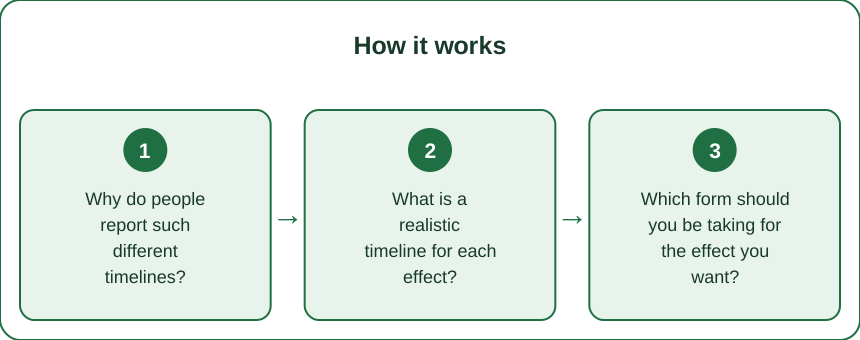
Why do people report such different timelines?
Because they are measuring different things and starting from different places.
Starting status is the largest variable. Someone genuinely low in magnesium has room to improve and will notice. Someone already adequately supplied has nothing to correct, and no supplement produces an effect in the absence of a deficit.
Blood tests do not settle this. Serum magnesium is tightly regulated and reflects only about 1 percent of total body magnesium. A normal serum level is compatible with depleted tissue stores, which is why the test is a poor guide for this specific question.
Different effects run on different clocks. The laxative effect of unabsorbed magnesium is a matter of hours. Neuromuscular effects run on days to weeks. Tissue repletion runs on months.
Form changes absorption substantially. Magnesium oxide is cheap, common, and poorly absorbed - a large fraction passes through, which is why it works as a laxative. Glycinate, citrate, and malate absorb considerably better.
And expectation shapes reporting. The first-night sleep improvement many people describe is difficult to separate from expectation - which does not mean it is not real to them, but does mean a two-week trial tells you more than a one-night one.
What is a realistic timeline for each effect?
Four different clocks, worth separating before you judge whether it is working.
Bowel effects: hours. Oxide and citrate at higher doses reliably loosen stools the same day. This is the fastest and most predictable magnesium effect and it is a dose-and-form problem rather than a benefit for most people.
Sleep quality: a few days to three weeks. Magnesium is involved in GABA signalling and NMDA receptor regulation, both relevant to sleep onset. Give it two to three weeks at a consistent evening dose before judging.
Muscle cramps and twitching: one to four weeks. If low magnesium was contributing, this is usually where the change is most noticeable. Eyelid twitching in particular often responds within days, though it has many other causes.
Tissue repletion: 6 to 12 weeks or longer. Roughly 60 percent of body magnesium sits in bone, and moving it back into storage is slow. This is why an eight-week trial is a fair test and a one-week trial is not.
A concrete trial protocol: pick glycinate at 200 to 400mg of elemental magnesium, take it at the same time each evening, and keep one simple note per day - sleep onset time, or cramp presence. Judge at week four, and again at week eight. Changing form or dose weekly makes the trial uninterpretable, which is what most people do.

Which form should you be taking for the effect you want?
Form determines both absorption and side effect, and the mismatch is common.
Glycinate (bisglycinate) for sleep and general repletion. Well absorbed, gentle on the bowel, and the glycine itself has a calming association. This is the default for most people, and the most expensive per milligram.
Citrate for constipation, or for general use if the bowel effect is welcome. Reasonably well absorbed and mildly laxative. A good compromise when both effects are wanted.
Malate for daytime use and muscle discomfort. Some prefer it for fatigue-related use, though the evidence for a distinct advantage is thin. It is well tolerated, which is the main practical point.
Oxide for laxative use, and not much else. Very high elemental magnesium per tablet and very poor absorption. A 500mg magnesium oxide tablet delivers far less usable magnesium than the label implies - a genuine trap when comparing prices.
Threonate is marketed for cognition on the basis of limited early research including animal work. Treat the cognitive claims as unproven and note it is expensive per milligram of elemental magnesium.
Read the elemental amount, not the compound amount. A label saying 1000mg magnesium citrate may contain around 160mg of elemental magnesium. This one distinction explains a great many under-dosed trials.
What Nobody Tells You About Magnesium Timelines
Diet moves the needle faster than most supplements. Pumpkin seeds, almonds, spinach, black beans, and dark chocolate are dense sources, and food magnesium comes with the cofactors and is absorbed steadily. Someone adding a daily handful of pumpkin seeds may correct faster than someone taking a poorly absorbed tablet.
Some medications and conditions deplete it continuously. Proton pump inhibitors, some diuretics, poorly controlled diabetes, chronic alcohol use, and gastrointestinal conditions affecting absorption all increase losses. If something is actively draining the tank, filling it takes longer and warrants a clinical conversation rather than a bigger dose.
Splitting the dose absorbs better. Absorption efficiency falls as a single dose rises. 200mg twice a day beats 400mg once, and it is gentler on the bowel.
Vitamin D and magnesium interact. Magnesium is required for vitamin D metabolism, and high-dose vitamin D supplementation increases magnesium demand. Someone who started high-dose D and then developed cramps has a plausible explanation available.
Kidney function is the important caution. The kidneys regulate magnesium excretion, so impaired kidney function makes supplementation genuinely risky. This is the one group who should not experiment - speak to a clinician first.
And the honest one: if eight weeks of adequate, well-absorbed magnesium changed nothing, the problem was probably not magnesium. That is a useful result rather than a failure - it redirects attention to sleep timing, caffeine, hydration, or something that needs proper investigation.
This is general information, not medical advice.
FAQ: Magnesium Timing Questions, Answered
How long before I should give up on it?
Eight weeks at 200 to 400mg of elemental magnesium in a well-absorbed form, taken consistently. Shorter trials, or trials where you switch forms every fortnight, cannot tell you anything.
Should I take it in the morning or evening?
Evening for sleep-related goals, since that is when the calming effect is useful. For general repletion, timing matters little - consistency matters more.
Does a blood test tell me if I am low?
Not reliably. Serum magnesium reflects about 1 percent of body stores and is tightly regulated, so it can read normal while tissue stores are depleted. It is useful for detecting significant deficiency, not for fine-tuning.
Why did it cause diarrhoea?
Unabsorbed magnesium draws water into the bowel. This is most common with oxide and citrate, and at higher single doses. Switch to glycinate and split the dose.
How much is too much?
Supplemental magnesium above roughly 350mg per day of elemental magnesium increases the chance of bowel effects, and much higher doses carry real risk in anyone with impaired kidney function. Food magnesium is not subject to the same limit.
Can I just eat more magnesium-rich food instead?
Often yes, and it is a reasonable first step. Pumpkin seeds, almonds, spinach, black beans, and dark chocolate are all dense sources, and dietary magnesium absorbs steadily without the bowel effects.
TL;DR:
- Bowel effects: hours. Sleep and cramps: one to three weeks. Tissue repletion: 6 to 12 weeks or more - judge the right effect on the right clock.
- Serum tests are a poor guide because only about 1 percent of body magnesium is in blood.
- Read elemental magnesium, not compound weight - a 1000mg citrate tablet may deliver around 160mg elemental.
- Glycinate for sleep, citrate if you want the bowel effect, oxide mostly as a laxative; split the dose for better absorption.
- Kidney impairment is a genuine contraindication - get medical advice first.
The most useful thing here is permission to run a proper eight-week trial and then accept the answer. If nothing changed, magnesium was not the bottleneck - and knowing that is worth more than another bottle of a different form.
This is general information, not medical advice.
Keep Reading
This article is for general informational purposes only and is not medical advice. Always consult a qualified health professional for guidance specific to you.