Magnesium and Restless Legs: Every Question, Answered
Quick Answer: Magnesium helps restless legs for some people and does nothing for others, and the evidence is genuinely mixed. It is most likely to help if you are actually low in magnesium. The much more important thing to check first is iron — low ferritin is a well-established driver of restless legs syndrome and is far more commonly the answer. Get iron studies before you spend months on magnesium.
Magnesium is the internet’s default answer for anything involving legs at night.
It is sometimes the right answer. But there is a different thing you should check first, and almost nobody mentions it.

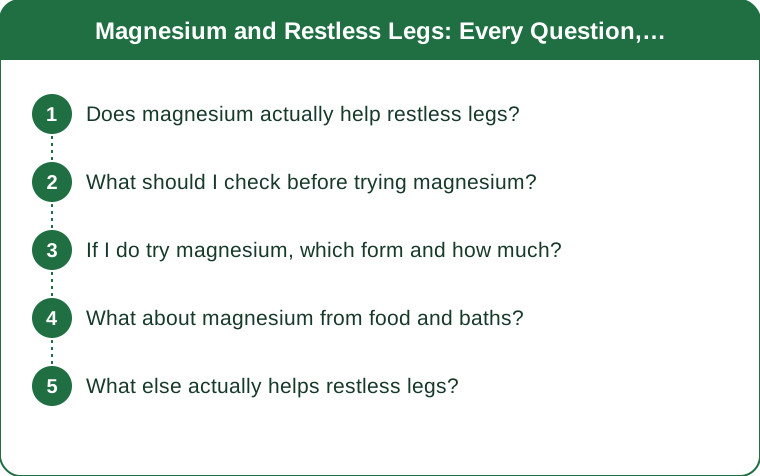
Does magnesium actually help restless legs?
What does the evidence show?
It is mixed and the studies are mostly small. Some trials and case reports show improvement, particularly in people with periodic limb movements during sleep, and others show no benefit over placebo. Reviews of the area generally conclude that the evidence is insufficient to recommend magnesium as a standard treatment, while noting it is low-risk to try.
Why does it work for some people and not others?
The most likely explanation is that it works when magnesium status was actually low to begin with. Correcting a deficiency produces a real effect; adding magnesium to someone already replete does not. Since most people never test their status, the results look random from the outside.
What would the mechanism be?
Magnesium acts as a natural calcium antagonist at the neuromuscular junction and modulates NMDA receptor activity. In principle that could reduce muscle excitability and the sensory symptoms. It is a plausible mechanism rather than a demonstrated one for this specific condition.
Is restless legs the same as nighttime leg cramps?
No, and conflating them causes a lot of confusion. Restless legs syndrome is an urge to move the legs, usually with an uncomfortable sensation, worse at rest and in the evening, relieved by movement. Cramps are sudden painful muscle contractions. They have different causes and different treatments, and magnesium has somewhat better support for cramps in pregnancy than for restless legs.
What should I check before trying magnesium?
Why does iron matter so much here?
Iron deficiency is one of the best-established contributors to restless legs syndrome. Brain iron is needed for dopamine synthesis, and dopaminergic dysfunction is central to the condition. Crucially, you can have normal hemoglobin — no anemia at all — and still have low brain iron stores.
What test should I ask for?
Ferritin, along with transferrin saturation. The thresholds used for restless legs are higher than the standard reference range: many specialists treat a ferritin below 75 micrograms per liter as worth supplementing in someone with symptoms, even though the lab will flag that as normal. This is why people get told their bloodwork is fine and continue having symptoms.
What else drives it?
Pregnancy, kidney disease, certain medications — including many antidepressants, antihistamines, and antinausea drugs — and a strong genetic component. Caffeine, alcohol, and nicotine reliably worsen symptoms in most people who have it.
So where does magnesium fit?
As a reasonable, low-risk thing to try after iron has been checked, and particularly if you have reason to think your magnesium intake is low. Not as the first move, and not as a substitute for finding out what is actually driving it.
This is general information, not medical advice. Restless legs syndrome is a diagnosable condition with effective treatments — persistent symptoms deserve a proper evaluation rather than a supplement trial.

If I do try magnesium, which form and how much?
Which form is best for this?
Magnesium glycinate is the usual choice — well absorbed, gentle on the digestive system, and the glycine itself has mild calming properties that suit an evening dose. Magnesium citrate is also well absorbed but has a laxative effect at higher doses, which is not what you want overnight.
Which forms should I avoid?
Magnesium oxide is the cheapest and the most common in supermarket supplements, and it is poorly absorbed — roughly a fraction of what glycinate delivers. Most people who say magnesium did nothing for them were taking oxide.
How much?
Typical supplemental doses in studies run around 200-400 mg of elemental magnesium in the evening. Check the label carefully: the number on the front is often the weight of the compound, not the elemental magnesium, and the difference is large.
When should I take it?
One to two hours before bed for restless legs specifically, since symptoms are worst in the evening and at rest.
How long before I know if it works?
Give it four to six weeks. Tissue magnesium repletion is not immediate, and a few nights tells you nothing. If six weeks at an adequate dose of a well-absorbed form has changed nothing, it is not your answer and continuing is not useful.
What about magnesium from food and baths?
Can I get enough from food?
Often yes, and it is the better starting point. Pumpkin seeds, almonds, spinach, black beans, dark chocolate, and whole grains are all substantial sources. A genuinely varied diet that includes these regularly puts most people in a reasonable range without supplementing.
Do Epsom salt baths raise magnesium levels?
The evidence for meaningful transdermal absorption is weak. Skin is a very effective barrier and the studies claiming absorption are small and methodologically limited. That said, a warm bath before bed genuinely helps many people with restless legs — through warmth, relaxation, and the temperature drop afterward that supports sleep onset. Enjoy the bath; do not count it as your magnesium dose.
What about magnesium sprays and lotions?
Same situation. Some people report benefit, the absorption evidence is thin, and any effect may be from the massage rather than the magnesium. Not harmful, not a substitute for oral intake if you are actually low.
Is a blood test for magnesium useful?
Only marginally. Serum magnesium reflects about one percent of total body magnesium and is tightly regulated, so it stays normal until deficiency is fairly advanced. A normal serum magnesium does not rule out suboptimal status, which is one reason this area is so murky.
What else actually helps restless legs?
What non-supplement changes make a difference?
Regular moderate exercise helps consistently — though intense exercise late in the evening can worsen symptoms for some people. Consistent sleep timing, a cooler bedroom, and reducing caffeine, alcohol, and nicotine all have reasonable support. Caffeine in particular is worth a genuine two-week trial of elimination.
Do stretching or massage help in the moment?
Yes, temporarily. Movement relieves the sensation by definition — that is part of the diagnostic criteria. Calf stretching, walking, and self-massage all provide short-term relief without addressing the underlying cause.
Should I check my medications?
Absolutely, and this is frequently overlooked. Many common medications worsen restless legs, including several antidepressants, sedating antihistamines, and antinausea medications. If your symptoms started or worsened after a medication change, that is worth raising with your prescriber — never stop a prescribed medication on your own.
When should I see a doctor?
If symptoms are disrupting your sleep more than a couple of nights a week, if they are worsening, if they started during pregnancy, or if you have kidney disease. Restless legs syndrome has effective prescription treatments and a specific workup, and iron correction alone resolves it for a meaningful share of people. It is very much worth a proper evaluation rather than years of supplement trials.
TL;DR:
- Magnesium evidence for restless legs is mixed and it most likely helps only if you were low to begin with
- Check ferritin first — low iron stores are a well-established driver, and the threshold for restless legs is higher than the standard lab range
- If trying it, use glycinate at 200-400 mg elemental in the evening, and give it four to six weeks before deciding
- Review your medications, cut caffeine and alcohol, and see a doctor if it is disrupting sleep regularly
Magnesium is a reasonable thing to try and a poor thing to try first. The iron test costs one blood draw and answers a much more common version of this question.
Keep Reading
This article is for general informational purposes only and is not medical advice. Always consult a qualified health professional for guidance specific to you.