Magnesium and Your Cycle: The Questions Worth Asking
Quick Answer: Magnesium has reasonable but not overwhelming evidence for menstrual cramps and some PMS symptoms, and better-established relevance to sleep and muscle function generally. It is not a treatment for a heavy or severely painful period, and severe symptoms deserve investigation rather than a supplement.
Where it does seem to help, the form and the timing matter more than the dose - glycinate for sleep and general use, citrate if constipation is part of the picture, and oxide mostly does not absorb well enough to be worth taking.
Here is what is actually known, question by question.

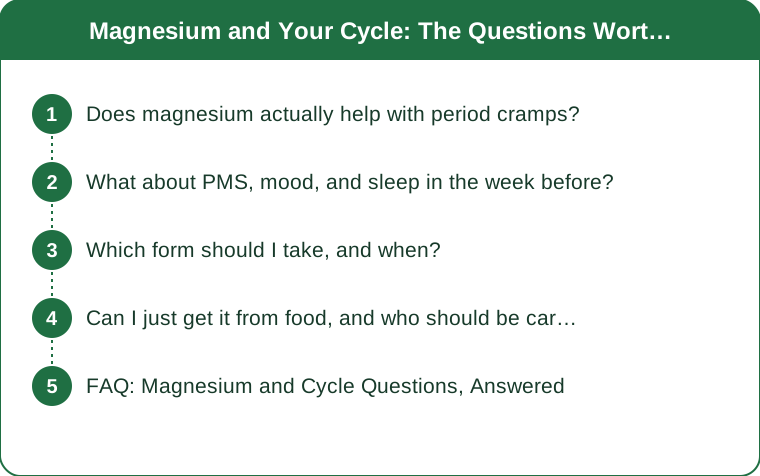
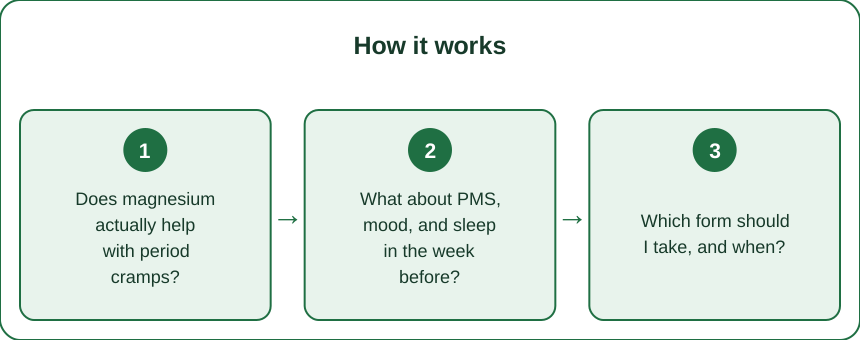
Does magnesium actually help with period cramps?
The evidence is moderately supportive and not conclusive, which is a less satisfying answer than most articles give.
The proposed mechanism is plausible. Magnesium is involved in muscle relaxation - it acts as a natural calcium antagonist, and calcium influx is what drives uterine muscle contraction. It also reduces prostaglandin production, and prostaglandins are a major driver of menstrual pain.
What the research shows. Several small trials have found reductions in menstrual pain with magnesium supplementation, and reviews generally describe the evidence as promising but limited by study size and quality. It is not in the same evidence tier as NSAIDs, which remain the better-supported first-line option for period pain.
Practically, what this means:
- Worth trying if your cramps are mild to moderate and you would rather not take painkillers every cycle
- Not a replacement for medical assessment if pain is severe, worsening, or interferes with your life
- Give it two to three cycles before deciding - the studies that found benefit generally dosed daily for a month or more, not just during the period
And the honest framing: severe period pain is common but not normal. Pain that keeps you off work, is getting worse, or does not respond to standard treatment warrants investigation for conditions like endometriosis, which is frequently diagnosed years later than it should be. This is general information, not medical advice.
What about PMS, mood, and sleep in the week before?
This is where the everyday case is strongest, though the evidence remains modest.
Mood and PMS symptoms. Some trials have found magnesium reduces PMS symptoms, particularly mood-related ones, and the effect appears better when combined with vitamin B6 than with magnesium alone. Effect sizes are moderate.
Sleep in the luteal phase. Sleep quality commonly worsens in the days before a period, and magnesium’s role in the nervous system - it regulates NMDA receptors and supports GABA activity - makes it a plausible support. The evidence for magnesium and sleep in general populations is mixed, with the clearest benefit in people who were deficient to begin with.
Cramps in the legs and feet. Nocturnal cramps are commonly reported in the premenstrual week, and magnesium is widely used for them. The trial evidence for leg cramps specifically is unimpressive, which is worth knowing before you spend money on it.
Water retention and bloating. Some evidence, again limited. The mechanism is unclear and the effect is not dramatic.
The realistic summary: magnesium is cheap, low-risk for most people, and may help with several of the things that cluster in that week. It is not going to transform a difficult premenstrual phase, and expecting that leads to disappointment. The people who notice the most are usually those with low intake to begin with - and low intake is common.

Which form should I take, and when?
The form matters considerably, and this is where most money gets wasted.
Glycinate. The best general-purpose choice - well absorbed, gentle on the digestive system, and the glycine component is itself mildly calming. This is the default recommendation for sleep, cramps, and general use.
Citrate. Well absorbed and mildly laxative, which is either a feature or a problem depending on you. If constipation is part of your premenstrual pattern, this is the sensible choice. If you are prone to loose stools, avoid it.
Malate. Well absorbed, sometimes preferred for daytime use because it is less sedating. Reasonable choice if glycinate makes you drowsy.
Oxide. Poorly absorbed - commonly cited absorption figures are in the single digits. It is cheap, it is what most supermarket supplements contain, and it is largely a laxative. If your supplement is not working, check whether this is what you bought.
Threonate. Marketed for cognitive benefit, considerably more expensive, and the human evidence is thin.
Timing:
- Evening for glycinate, since any sedative effect is useful then
- With food, which improves tolerance
- Split the dose if you are taking more than about 200mg, which improves absorption and reduces digestive effects
- Daily rather than only during your period - the trials showing benefit generally used continuous daily supplementation
Dose: the general adult recommendation is around 310 to 320mg daily from all sources, and supplemental doses in studies are commonly 200 to 400mg. The upper limit for supplemental magnesium is around 350mg daily for adults - above that, digestive effects are common.
Can I just get it from food, and who should be careful?
Food first is a genuinely reasonable position, and it is what most clinicians would suggest before a supplement.
The best food sources:
- Pumpkin seeds - among the densest sources available, roughly 150mg per ounce
- Dark leafy greens - spinach, chard
- Almonds, cashews, and most nuts
- Dark chocolate, at 70 percent or higher. The premenstrual chocolate craving is not evidence of a magnesium requirement, and it is a genuinely decent source
- Black beans, edamame, and legumes generally
- Whole grains
Why intake is commonly low. Refining grains removes most of the magnesium, and modern diets are heavy on refined carbohydrates. A substantial proportion of adults in Western populations fall short of the recommended intake, which is part of why supplementation often produces a noticeable effect.
Who should be careful or consult first:
- Anyone with kidney disease. The kidneys clear excess magnesium - if they are impaired, it accumulates, and this is a genuine safety issue rather than a precaution
- Anyone taking certain antibiotics - magnesium interferes with absorption of tetracyclines and quinolones. Separate doses by several hours
- Anyone on bisphosphonates, thyroid medication, or certain diuretics - interactions exist and are worth checking
- Anyone with a heart condition or taking heart medication
Signs of too much: loose stools and abdominal discomfort are the first and most common, and they are the body’s own limit. They usually mean the dose or the form is wrong rather than that magnesium is unsuitable.
And a general point: discuss supplementation with a clinician or pharmacist if you take any regular medication. This is general information, not medical advice.
FAQ: Magnesium and Cycle Questions, Answered
How long before I know if it is working?
Give it two to three full cycles of daily use. The studies that found benefit dosed continuously for weeks rather than only during symptoms, and a single cycle tells you very little given how much cycles vary naturally.
Does an Epsom salt bath do anything?
It is relaxing, and the evidence for meaningful magnesium absorption through skin is weak. If the bath helps, the heat and the twenty quiet minutes are doing most of the work - which is a perfectly good reason to have one.
Should I take more during my period specifically?
The trials generally used a consistent daily dose rather than cycling it, and consistency is easier to maintain anyway. If you want to adjust, some people take theirs in the evening throughout and simply do not skip during the premenstrual week, which is when it is easiest to forget.
Can magnesium replace painkillers for cramps?
For mild cramps, some people find it reduces how often they reach for one. For moderate to severe pain, NSAIDs have considerably better evidence, and pain that requires managing every cycle is worth discussing with a clinician rather than optimising a supplement around.
TL;DR:
- Evidence for magnesium and menstrual cramps is moderate and promising, not conclusive
- The mechanism is plausible - muscle relaxation and reduced prostaglandin production
- Glycinate is the best general choice; oxide absorbs poorly and is mostly a laxative
- Take it daily rather than only during your period, and allow two to three cycles
- Severe or worsening period pain warrants investigation, not a supplement
If you already take magnesium and notice nothing, check the label for oxide. That alone explains a lot of disappointing results.
Keep Reading
This article is for general informational purposes only and is not medical advice. Always consult a qualified health professional for guidance specific to you.