Magnesium Timing: Every Question You Have, Answered
Quick Answer: For sleep and relaxation, take magnesium one to two hours before bed. For general repletion, timing barely matters — consistency does. Take it with food to reduce stomach upset and improve tolerance, split doses above about 200 milligrams because absorption falls as dose rises, and separate it by at least two hours from iron, zinc, calcium and certain antibiotics. Expect two to four weeks before subtle effects, and immediate effects only for sleep and constipation.
Every question people actually ask about magnesium timing, answered in order.

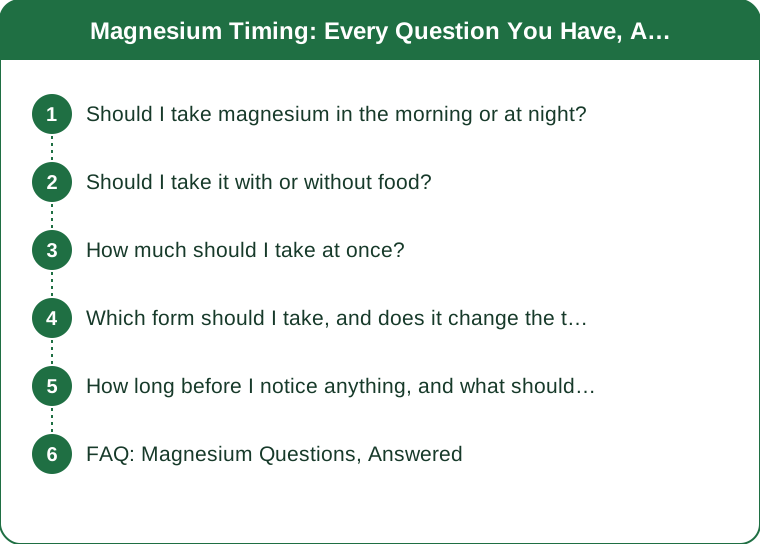
Should I take magnesium in the morning or at night?
It depends entirely on why you are taking it.
For sleep: evening, one to two hours before bed. Magnesium contributes to nervous system regulation and is involved in GABA activity, and most people who take it for sleep find the evening timing works best subjectively.
For muscle cramps: evening, if the cramps are nocturnal. Night cramps are the most common complaint and evening dosing aligns with when you want the effect. The evidence for magnesium in cramp prevention is genuinely mixed, and it works well for some people and not others.
For general repletion: whenever you will actually remember. If you are correcting a low intake, blood and tissue levels respond to total daily intake over weeks. The specific hour is essentially irrelevant.
For constipation: it depends on the form. Magnesium citrate and oxide have a laxative effect. Morning dosing gives you daytime effect; evening dosing means it may work overnight.
For exercise performance: not acutely useful. Magnesium is not a pre-workout. Repletion over weeks matters; a dose 30 minutes before training does nothing.
If it energises you, switch to morning. A minority of people report feeling alert rather than relaxed. That is a good reason to move the dose.
Should I take it with or without food?
With food, for almost everyone.
Food substantially improves tolerance. The most common problem with magnesium is gastrointestinal upset, and taking it with a meal reduces this considerably.
Absorption is reasonably good either way. Fractional absorption is somewhat higher on an empty stomach for some forms, but the difference is small and rarely worth the discomfort.
High-fibre and high-phytate meals reduce absorption somewhat. Phytates in whole grains and legumes bind minerals. This is a modest effect and not a reason to change your diet.
Avoid taking it with very high calcium meals. Calcium and magnesium compete for absorption to some extent. A large dairy-heavy meal at the same moment as a magnesium supplement is not ideal, though the effect is often overstated.
Alcohol increases magnesium excretion. Regular alcohol intake is a genuine contributor to low magnesium status, and a supplement does not fully offset it.
Water matters for tolerance. Take it with a full glass, especially with citrate or oxide.
How much should I take at once?
Less than you probably think, split more often than you probably do.
Fractional absorption falls as dose rises. At small doses a much higher percentage is absorbed than at large doses. Two 150 milligram doses deliver more absorbed magnesium than one 300 milligram dose.
Split anything above about 200 milligrams. Morning and evening is the practical split, or with two meals.
Typical supplemental doses are 200 to 400 milligrams of elemental magnesium daily. Note that this is elemental magnesium, not the weight of the compound — 500 milligrams of magnesium citrate contains far less than 500 milligrams of magnesium. Check the label carefully.
The tolerable upper intake level for supplements is around 350 milligrams of elemental magnesium daily for adults in many guidelines. This applies to supplements, not to magnesium from food, which is not restricted in the same way.
Diarrhoea is the dose-limiting signal. It is the standard indicator that you have exceeded what your gut can handle, and it appears at lower doses with oxide and citrate.
People with kidney impairment must not self-supplement. Magnesium is cleared renally, and impaired clearance can lead to dangerous accumulation. This is a genuine safety issue and requires medical supervision. This is general information, not medical advice.

Which form should I take, and does it change the timing?
The form changes tolerance, absorption and side effects far more than timing does.
Glycinate: best for sleep and general use. Well absorbed, gentle on the stomach, no meaningful laxative effect. The glycine component may itself support sleep. This is the default recommendation for evening dosing.
Citrate: well absorbed, mild laxative effect. Good general choice, and the right one if you also want help with constipation. Less ideal if you do not.
Oxide: poorly absorbed, strong laxative effect. Cheap and common, which is why so many people conclude magnesium upsets their stomach. Fine as a laxative, poor as a repletion supplement.
Malate: well tolerated, sometimes preferred for daytime. Some people report it feels less sedating than glycinate, though this is anecdotal.
L-threonate: marketed for cognitive effects. Interesting preliminary research, considerably more expensive, and the evidence in humans is still limited.
Topical magnesium: poor evidence for meaningful absorption. Epsom salt baths are pleasant and relaxing; the case that they meaningfully raise magnesium status is weak.
Match form to purpose: glycinate at night for sleep, citrate if constipation is also an issue, and avoid oxide unless the laxative effect is what you want.
How long before I notice anything, and what should I not take it with?
Two different answers, and the interaction list is short but important.
Sleep effects, if they happen, are often noticed within days. Many people report a subjective difference in the first week. Whether that is a genuine effect or expectation is difficult to separate at the individual level.
Cramp and muscle effects take two to four weeks. Tissue repletion is not fast. Judging after three days is too soon.
General repletion takes weeks to months. Serum magnesium is tightly regulated and a normal blood level does not rule out low total body magnesium, which is part of why deficiency is under-recognised.
Separate from iron and zinc by at least two hours. They compete for absorption.
Separate from calcium supplements. Same reason, though the effect is modest at normal doses.
Separate from tetracycline and quinolone antibiotics by two to four hours. Magnesium binds them and substantially reduces their absorption. This one matters clinically.
Separate from levothyroxine by at least four hours. Magnesium interferes with its absorption.
Bisphosphonates need separation too. Check the specific instructions for your medication.
Some medications increase magnesium loss. Proton pump inhibitors used long term, some diuretics, and regular alcohol all deplete magnesium. Worth discussing with a pharmacist if any apply to you.
Seasonal note: magnesium requirements do not change with the season, but sleep problems often worsen as daylight shortens through autumn. If you start supplementing at the same time as the clocks change, expect the two effects to be tangled together and give it a fair trial before judging.
FAQ: Magnesium Questions, Answered
Can I take it every day long term?
At typical supplemental doses, yes for most people with normal kidney function. Discuss with a clinician if you have kidney disease or take interacting medication.
Should I take it on rest days too?
Yes. Repletion depends on consistent daily intake, not on training days.
Does a blood test tell me if I am deficient?
Only partly. Serum magnesium is tightly regulated and can be normal despite low total body stores, which is a known limitation.
Can I get enough from food?
Many people can. Leafy greens, nuts, seeds, legumes, whole grains and dark chocolate are all good sources, and food-based magnesium comes without the upper-limit concerns.
What if it gives me diarrhoea?
Reduce the dose, split it, take it with food, and switch from oxide or citrate to glycinate.
Is it safe in pregnancy?
Magnesium is often used in pregnancy, but dose and form should be discussed with your midwife or doctor rather than self-selected.
TL;DR:
- Evening, one to two hours before bed for sleep. Timing barely matters for general repletion.
- Take it with food, and split doses above 200 milligrams — absorption falls as dose rises.
- Glycinate for sleep, citrate if constipation is also an issue, avoid oxide for repletion.
- Separate by two to four hours from iron, zinc, calcium, thyroid medication and certain antibiotics.
- Give it two to four weeks for anything other than sleep and bowel effects.
Check the elemental magnesium on your label. Most people are taking less than they think.
Keep Reading
This article is for general informational purposes only and is not medical advice. Always consult a qualified health professional for guidance specific to you.