Should You Take Magnesium in the Morning or at Night?
Quick Answer: Timing matters less than form and consistency. Magnesium glycinate and threonate are commonly taken at night because glycine may support sleep quality; citrate and oxide have a laxative effect that many people prefer to manage during the day. If magnesium upsets your stomach, take it with food. The most important variable is taking it daily at all.
Search magnesium timing and you will find confident, contradictory answers within the first three results.
Take it at night for sleep. Take it in the morning for energy. Split the dose. Never take it with calcium. Always take it with food.
Most of that advice is generalizing from one specific form to all of them, and that is where the confusion starts.
This is general information, not medical advice.

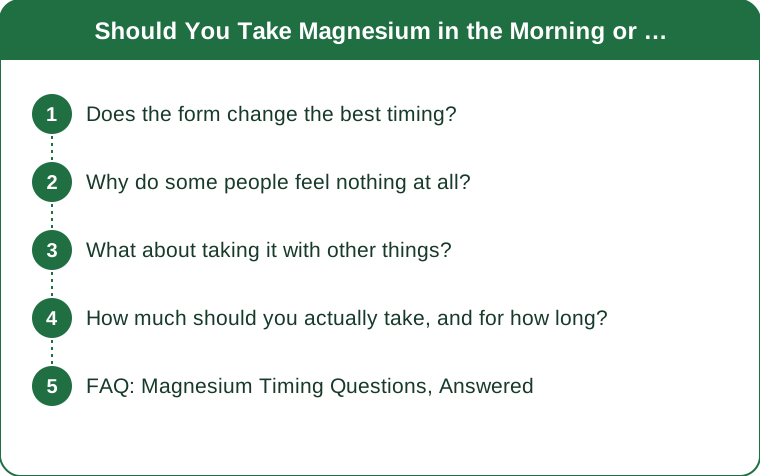
Does the form change the best timing?
More than the clock does. The common forms behave quite differently.
Magnesium glycinate (bisglycinate). Bound to glycine, well tolerated, minimal laxative effect. Glycine itself has been studied for sleep quality, which is the main reason this form is typically suggested in the evening. Gentle on the stomach.
Magnesium citrate. Well absorbed and noticeably laxative at higher doses. Many people take it in the morning simply so the digestive effect happens during the day rather than at 2am. Also the form most often used deliberately for constipation.
Magnesium oxide. Poorly absorbed, strongly laxative, cheap and very common in drugstore products. If a supplement is inexpensive and upsets your stomach, this is usually why.
Magnesium L-threonate. Marketed for cognitive effects based on early research; generally taken in the evening. Expensive, and the evidence base is thinner than the marketing suggests.
Magnesium malate. Sometimes suggested for daytime use in the context of fatigue, though evidence for an energizing effect specifically is limited.
So the practical rule: let tolerability and your own response set the timing. There is no universal metabolic clock argument that outweighs whether the form sits well with you.
Why do some people feel nothing at all?
A few reasons, and they are worth ruling out before concluding magnesium does not work for you.
- You were not deficient. Supplementing a nutrient you already have adequate amounts of typically produces no noticeable effect. That is not failure — it is the expected result.
- The form is poorly absorbed. Oxide has low bioavailability, and a large number on the label does not equal a large amount absorbed.
- Elemental versus compound weight. A 500mg magnesium citrate capsule does not contain 500mg of magnesium — the elemental content is a fraction of the total. Check the label for elemental magnesium, which is the number that matters.
- Not long enough. Repleting tissue stores takes weeks, not days. Two to four weeks is a more reasonable trial than three nights.
- The expected effect was unrealistic. Magnesium is not a sedative. Where it helps sleep, the effect is typically modest and gradual rather than dramatic.
Blood tests are also less informative than people assume here, since serum magnesium reflects only a small share of total body magnesium and stays fairly stable even when stores are lower. That is a conversation for a clinician rather than a self-assessment.

What about taking it with other things?
A few interactions genuinely matter and a few are overstated.
Worth spacing out:
- Certain antibiotics and thyroid medication. Magnesium can reduce absorption of some of these — typically a 2 to 4 hour gap is advised, and this one is worth checking with a pharmacist for your specific medication
- Very high-dose zinc, which can compete for absorption at large doses
- Bisphosphonates and some other prescription medications
Overstated:
- Calcium. Modest amounts in the same meal do not meaningfully interfere for most people
- Food generally. Taking magnesium with food improves tolerability for many, and any small effect on absorption is a fair trade if it means you keep taking it
Genuinely helpful:
- Splitting the dose. Two smaller doses are often better tolerated and better absorbed than one large one, particularly above roughly 200mg elemental
- Taking it with a small snack if it causes any nausea
If you take prescription medication of any kind, run a new supplement past a pharmacist. It is free and it takes two minutes.
How much should you actually take, and for how long?
Adult daily requirements are commonly cited around 310 to 420mg of elemental magnesium from all sources, food included — and food matters here, since leafy greens, nuts, seeds, legumes, and whole grains contribute substantially.
For supplementation:
- Start low, around 100 to 200mg elemental, and increase gradually
- Watch for loose stools. That is the practical ceiling for most people and it arrives at different doses depending on form
- Give it three to four weeks before deciding whether it does anything for you
- Take it daily. Consistency matters more than timing, dose splitting, or which premium form you chose
Upper limits for supplemental magnesium exist for good reason, and people with kidney impairment need medical guidance before supplementing at all, since impaired clearance changes the risk profile entirely.
And the unglamorous point: most people would get more from eating more magnesium-rich food than from optimizing capsule timing. A handful of pumpkin seeds, a serving of black beans, or a couple of squares of dark chocolate all contribute meaningfully.
FAQ: Magnesium Timing Questions, Answered
Will magnesium actually help me sleep?
For some people, modestly — especially if intake was low to begin with, and particularly with the glycinate form. It is not a sleep medication and should not be expected to behave like one.
Can I take it on an empty stomach?
You can, but tolerability is worse for many forms. If you get nausea or cramping, move it to a meal.
Is a topical magnesium spray or bath as effective as oral?
Evidence for meaningful absorption through skin is weak. An Epsom salt bath may be relaxing for other reasons, but do not count on it for repletion.
This is general information, not medical advice. Talk to a clinician or pharmacist before starting supplements, especially with kidney conditions or prescription medications.
TL;DR:
- Form matters more than timing: glycinate and threonate suit evening, citrate and oxide often suit daytime
- Check elemental magnesium on the label, not total compound weight
- Loose stools are your practical dose ceiling; split doses above roughly 200mg
- Give it three to four weeks, take it daily, and eat more magnesium-rich food regardless
If magnesium has done nothing for you, check the form and the elemental number on your bottle before concluding it does not work. Those two lines explain most disappointments. General information, not medical advice.
Keep Reading
This article is for general informational purposes only and is not medical advice. Always consult a qualified health professional for guidance specific to you.