Which Form of Magnesium Should You Take, and For What?
Quick Answer: Glycinate for sleep and general supplementation — well absorbed, gentle on the gut. Citrate for constipation — absorbs reasonably and has a laxative effect that’s a feature or a bug depending on your goal. Oxide is poorly absorbed and mostly useful as a laxative despite being the cheapest and most common. Malate and threonate have narrower use cases. Most disappointing magnesium experiences come from taking oxide and concluding magnesium doesn’t work.
The form on the label matters more than the milligram number on the front.

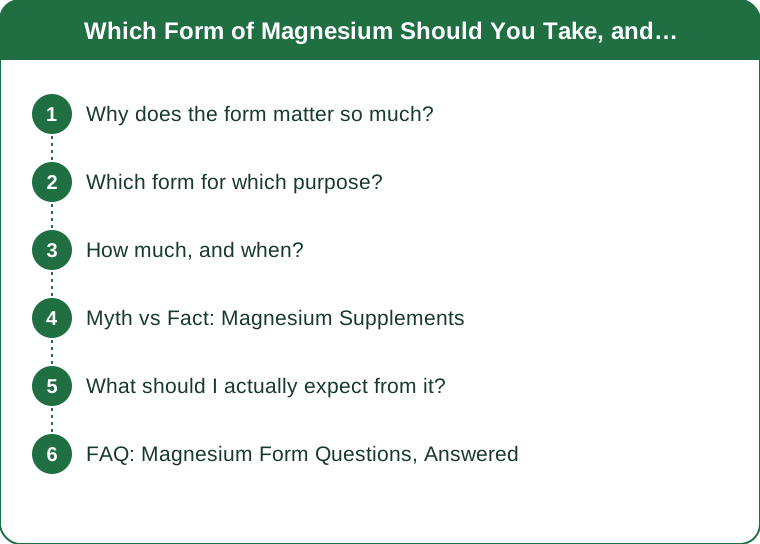
Why does the form matter so much?
Because bioavailability varies dramatically between forms, and the label number is elemental magnesium, not absorbed magnesium.
Magnesium is always bound to something — an amino acid, an organic acid, or an oxide. That partner determines how well it’s absorbed and how it’s tolerated.
Organic forms — glycinate, citrate, malate — are generally better absorbed than inorganic oxide. Estimates of oxide absorption run low, often cited around 4%, though methodology varies considerably across studies.
Poorly absorbed magnesium stays in the intestine, where it draws water in osmotically. That’s why oxide and citrate cause loose stools — the unabsorbed portion is acting as an osmotic laxative.
This is also why “more magnesium” often just means “more diarrhea.” The gut has a ceiling on absorption per dose, and exceeding it produces bowel effects rather than higher levels.
Which is why splitting doses works better than one large one for anyone taking a meaningful amount.
Which form for which purpose?
A short practical mapping.
Magnesium glycinate (bisglycinate): sleep, general supplementation, anyone with a sensitive gut. Bound to glycine, which is itself associated with sleep quality. Well absorbed and the least likely to cause digestive effects — this is the default recommendation for most people.
Magnesium citrate: constipation, and general supplementation if you tolerate it. Reasonably absorbed, inexpensive, widely available. The laxative effect is dose-dependent — a feature if that’s what you want, a problem if it isn’t.
Magnesium oxide: primarily a laxative and antacid. Cheapest and most common in general multivitamins, which is unfortunate, because poor absorption means it’s a poor choice for correcting status.
Magnesium malate: sometimes suggested for fatigue and muscle discomfort, based on malate’s role in energy metabolism. The specific evidence is limited but it’s well absorbed and well tolerated.
Magnesium L-threonate: marketed for cognitive effects based on animal data suggesting better brain penetration. Human evidence is limited and it’s considerably more expensive.
Magnesium chloride and sulfate (Epsom salts): topical use is popular; transdermal absorption evidence is weak. An Epsom bath may be genuinely relaxing without much magnesium crossing the skin.
How much, and when?
Typical supplemental doses run 200 to 400mg elemental, and timing depends on the goal.
Check the elemental amount, not the compound weight. A 500mg magnesium glycinate capsule may contain only around 50 to 100mg of elemental magnesium — the rest is glycine. This is the single most common source of confusion.
For sleep: 200 to 400mg elemental, 30 to 60 minutes before bed. Glycinate is the usual choice.
For constipation: citrate, and the effective dose varies widely between individuals. Start low.
For general supplementation: split into two doses, with food. Absorption per dose is limited, so 2 x 150mg generally beats 1 x 300mg.
Taking it with food improves tolerability and doesn’t meaningfully hurt absorption for most forms.
RDA for adult women is roughly 310 to 320mg per day from all sources, which includes food — and magnesium is reasonably available in leafy greens, nuts, seeds, legumes, and whole grains. Supplementation is topping up, not replacing.
Talk to your doctor before supplementing if you have kidney disease — impaired kidney function significantly changes magnesium handling and can lead to accumulation. Also check for interactions if you take antibiotics, thyroid medication, or bisphosphonates, all of which can be affected by magnesium timing. This is general information, not medical advice.

Myth vs Fact: Magnesium Supplements
Myth: Everyone is magnesium deficient. Fact: Intake below recommended levels is common; frank clinical deficiency is much less so. Serum magnesium is also a poor marker of status — most body magnesium is intracellular and in bone, so a normal blood level doesn’t rule out suboptimal status. This ambiguity is exactly what makes the “everyone is deficient” claim both unfalsifiable and popular.
Myth: More is better. Fact: Absorption per dose is limited and excess mostly produces diarrhea. Splitting doses is more effective than increasing them.
Myth: Topical magnesium works as well as oral. Fact: Evidence for meaningful transdermal absorption is weak. Epsom baths may be relaxing for other reasons — warmth, quiet, time — which is a fine reason to take one.
Myth: Magnesium is a sleep aid. Fact: It’s not a sedative. Evidence for sleep benefit is strongest in people with low intake or deficiency. If your magnesium status is adequate, the effect on sleep is likely small.
Myth: It will stop my muscle cramps. Fact: Evidence for magnesium reducing exercise-associated or nocturnal cramps is mixed and generally unimpressive, despite how widely it’s recommended. Some people report benefit; the trial data doesn’t strongly support it.
Myth: The form doesn’t matter, magnesium is magnesium. Fact: This is the belief that leads people to buy oxide, absorb very little, and conclude the mineral does nothing for them.
What should I actually expect from it?
Modest, and larger if your intake was genuinely low.
If your dietary intake is low, correcting it can produce noticeable effects on sleep quality, muscle comfort, and general wellbeing over several weeks.
If your intake is already adequate, expect much less. Supplementation corrects a shortfall; it doesn’t add a benefit on top of sufficiency.
Give it 4 to 8 weeks. Tissue magnesium status changes slowly, and judging after a few days tells you little.
Improve dietary intake alongside. Pumpkin seeds, almonds, spinach, black beans, and dark chocolate are all substantial sources — and food sources come with other things you need.
Watch for the obvious signal that you’re taking too much: loose stools. That’s the reliable indicator to reduce the dose or change the form.
And be realistic. Magnesium is one input. It won’t resolve sleep problems driven by stress, schedule, caffeine, or a sleep disorder, and it’s frequently recommended as if it might.
FAQ: Magnesium Form Questions, Answered
Can I test my magnesium level?
Serum magnesium is the standard test but it’s a poor indicator of total body status, since the body maintains blood levels tightly by drawing from bone and tissue. RBC magnesium is sometimes used and is somewhat better. Neither is definitive, which is a genuine limitation.
Should I take it with calcium?
They compete for absorption to some degree, so taking them at different times is generally better if you supplement both. If they’re combined in one product, that’s not harmful — just somewhat less efficient.
Is magnesium safe long term?
For people with normal kidney function and typical supplemental doses, it’s generally considered safe. Excess is excreted by the kidneys. Impaired kidney function changes this substantially and requires medical guidance.
Why did glycinate work for my friend and not for me?
Most likely difference in baseline status. Someone with low intake will notice a change; someone already sufficient won’t. It can also be that the actual issue — sleep, cramps, fatigue — has a different cause that magnesium was never going to address.
TL;DR: The form on the back of the label matters more than the number on the front.
- Glycinate: sleep, general use, sensitive stomachs. Well absorbed, gentle. The default for most people.
- Citrate: constipation, or general use if tolerated. The laxative effect is dose-dependent.
- Oxide: poorly absorbed, mainly a laxative — and the most common form in cheap multivitamins.
- Check elemental magnesium, not compound weight. A 500mg capsule may hold 100mg of actual magnesium.
- Split doses. Absorption per dose is capped; 2 x 150mg beats 1 x 300mg. Loose stools mean too much.
- Expect modest effects, larger if your intake was genuinely low. Give it 4 to 8 weeks.
If you have kidney disease, talk to your doctor first — impaired kidney function changes magnesium handling substantially.
Keep Reading
This article is for general informational purposes only and is not medical advice. Always consult a qualified health professional for guidance specific to you.