Why Magnesium Doesn't Seem to Help Your Sleep (Yet) — 4 Fixable Reasons
Quick Answer: Magnesium for sleep commonly ‘fails’ because of wrong form (oxide instead of glycinate/citrate), too-low dose, wrong timing, or an underlying deficiency that isn’t actually the cause of the sleep issue. Checking these four in order usually explains a no-effect result.
You’ve been taking magnesium every night for two weeks and your sleep hasn’t budged. Before assuming it’s not for you, walk through these four checkpoints — most ‘magnesium doesn’t work’ stories trace back to one of them.

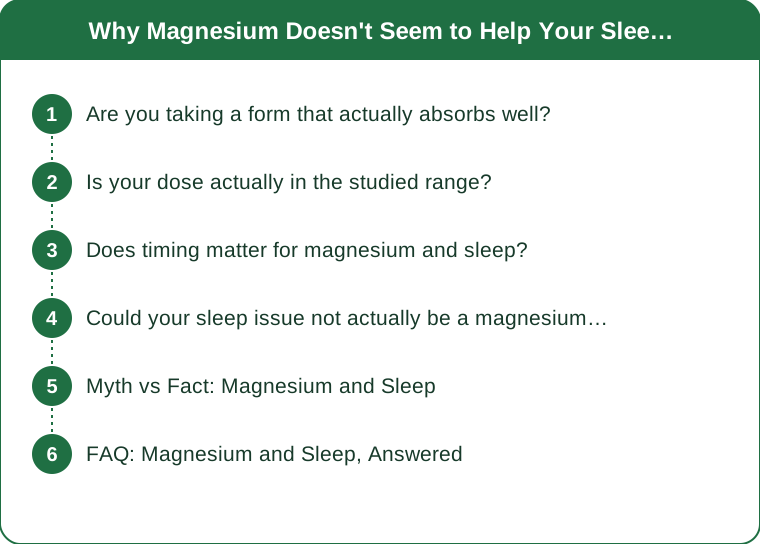
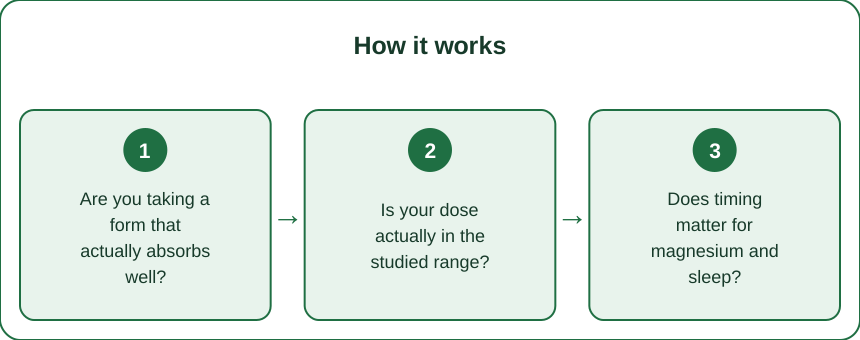
Are you taking a form that actually absorbs well?
Magnesium oxide, the cheapest and most common drugstore form, has notably poor absorption — much of it passes through the gut largely unused, and its main reliably-documented effect is a laxative one, not a sleep one. Glycinate and citrate forms are better absorbed and are the forms most commonly used in sleep-focused research. If your bottle just says ‘magnesium oxide,’ that’s the first thing to change.
Is your dose actually in the studied range?
Sleep studies using magnesium typically use 200-400mg of elemental magnesium — check your label carefully, since some products list the compound weight (like 500mg magnesium glycinate) rather than elemental magnesium, which is usually a smaller number written in fine print. A dose well under 200mg elemental is unlikely to match what was actually tested.
Does timing matter for magnesium and sleep?
Yes — most protocols use it 30-60 minutes before bed, not with dinner or earlier in the day. Taking it too early misses the window where its mild calming effect on the nervous system would actually overlap with your wind-down period.

Could your sleep issue not actually be a magnesium issue?
This is the one people skip. Magnesium’s sleep benefit is most reliably shown in people with an actual mild deficiency or specific issues like restless legs — not as a universal sedative for anyone with any kind of sleep trouble. If your sleep issue is driven by screen use before bed, irregular schedule, or anxiety, magnesium alone is unlikely to move the needle much, regardless of form or dose.
Myth vs Fact: Magnesium and Sleep
Myth: More magnesium means better sleep. Fact: Above the studied range, extra magnesium mostly just increases GI side effects like loose stools — there’s no evidence more equals better sleep past a certain point.
Myth: All magnesium supplements are basically the same. Fact: Absorption and side-effect profile vary a lot by form — oxide, citrate, glycinate, and threonate behave quite differently in the body.
Myth: If it doesn’t work in 2-3 nights, it’s not for you. Fact: Most studies run 4-8 weeks before assessing effect; a few nights isn’t a fair trial for a mineral working on baseline nervous system tone, not acting like a sedative drug.
FAQ: Magnesium and Sleep, Answered
How long before magnesium’s sleep effect shows up?
Most studies assess effect at 4-8 weeks of consistent nightly use, not after a few nights.
Can you take too much magnesium for sleep?
Yes — doses well above 350-400mg elemental commonly cause GI upset, and very high doses carry other risks; more isn’t better past the studied range.
Should you check with a doctor before starting magnesium for sleep?
Yes, especially if you take any medication, since magnesium can interact with certain antibiotics, blood pressure medications, and diuretics.
TL;DR:
- Oxide form absorbs poorly; glycinate or citrate are better studied choices
- Check elemental magnesium dose, not just the compound weight on the label
- Take it 30-60 minutes before bed, not earlier in the day
- Give it 4-8 weeks — and it works best for actual deficiency-driven sleep issues
This is general information, not medical advice. Before writing off magnesium, make sure you actually gave it a fair, well-dosed, well-timed trial.
Keep Reading
This article is for general informational purposes only and is not medical advice. Always consult a qualified health professional for guidance specific to you.