Why Magnesium Glycinate Works Wonders for Some People and Does Nothing for Others
Quick Answer: Magnesium glycinate mainly helps sleep and relaxation when you’re actually deficient to begin with — if your levels are already adequate, adding more magnesium has little room to produce a noticeable effect, which explains why the same supplement transforms one person’s sleep and does nothing for another’s.
Why does the exact same magnesium glycinate dose transform one person’s sleep and do absolutely nothing for the person next to them taking it? The answer lives mostly in where each person’s magnesium levels started.

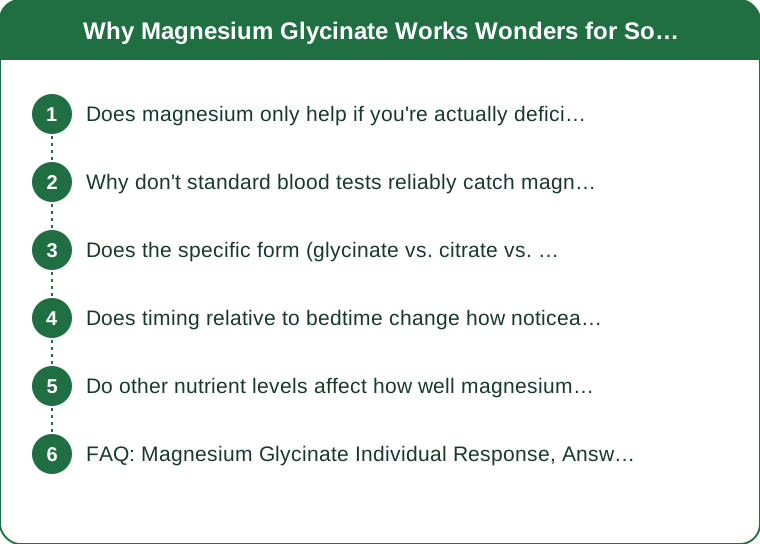
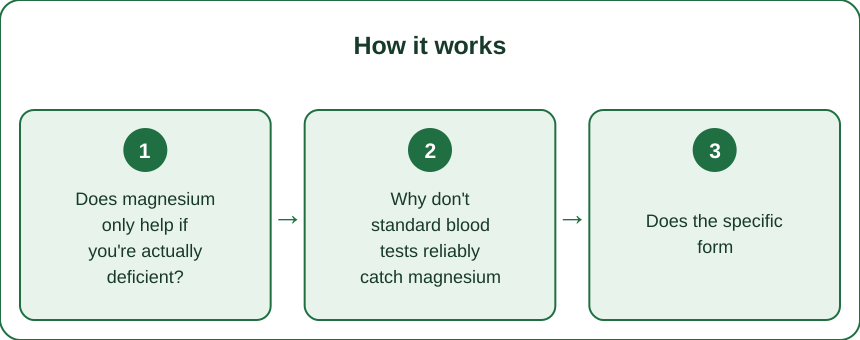
Does magnesium only help if you’re actually deficient?
Largely yes. Magnesium supports over 300 enzymatic processes including ones involved in nervous system regulation and muscle relaxation, but supplementing when your levels are already sufficient doesn’t meaningfully improve those processes further — there’s a ceiling effect that standard blood tests don’t always catch, since blood magnesium reflects only about 1% of total body stores.
Why don’t standard blood tests reliably catch magnesium deficiency?
Most of the body’s magnesium is stored in bone and muscle tissue, not blood, so a normal blood magnesium reading doesn’t rule out a functional deficiency in tissue stores. This is why some people with ‘normal’ labs still respond dramatically to supplementation — the blood test simply wasn’t measuring the pool that mattered.
Does the specific form (glycinate vs. citrate vs. oxide) explain some of the difference?
Partly — glycinate has notably better absorption and fewer digestive side effects than oxide, so someone taking a poorly absorbed form may see less effect not because they don’t need magnesium, but because little of it is actually being absorbed. Comparing forms before concluding magnesium ‘doesn’t work for you’ is worth doing first.

Does timing relative to bedtime change how noticeable the effect is?
Yes — glycinate taken 30-60 minutes before bed has time to support the relaxation response as sleep approaches; taken with breakfast, the same dose is metabolized well before bedtime and any subtle calming effect has already passed by the time it would matter.
Do other nutrient levels affect how well magnesium works?
Vitamin D and magnesium have an interdependent relationship — vitamin D metabolism actually requires magnesium as a cofactor, and low vitamin D status can blunt how effectively supplemented magnesium gets utilized. Someone low in both may see less benefit from magnesium alone than expected.
FAQ: Magnesium Glycinate Individual Response, Answered
How long should you try magnesium glycinate before deciding it doesn’t work?
At least 3-4 weeks of consistent nightly use — magnesium repletion in tissue stores happens gradually, not in a single dose, so a one-week trial often undersells the actual effect.
Should you test magnesium levels before supplementing?
A red blood cell (RBC) magnesium test is more reflective of tissue stores than standard serum magnesium and is worth asking a doctor about if you’re unsure whether deficiency is the actual issue.
Can taking too much magnesium glycinate cause problems?
Excess magnesium beyond what the body needs is usually excreted, though very high doses can cause loose stools — glycinate causes this less often than oxide or citrate, but it’s not impossible at high doses.
TL;DR:
- Magnesium mainly helps when you’re actually deficient — supplementing past adequate levels has little room to improve things further
- Standard blood tests miss most functional deficiency since blood holds only about 1% of total body magnesium
- Poor absorption (wrong form) or poor timing (too early in the day) can make an effective supplement look ineffective
- Give it 3-4 weeks of consistent nightly use before concluding it isn’t working for you
Before writing off magnesium glycinate, check the form, the timing, and how long you’ve actually given it a fair trial.
Keep Reading
This article is for general informational purposes only and is not medical advice. Always consult a qualified health professional for guidance specific to you.