Why Magnesium Supplements Sometimes Do Nothing, Even When Taken Consistently
Quick Answer: Magnesium supplements often show no noticeable effect because of poor absorption from certain forms, an already-adequate baseline level, or a dose too low to address an actual deficiency. Switching to a more bioavailable form and confirming an actual deficiency first resolves most non-response cases.
Taking magnesium every night for a month with zero noticeable change usually points to a specific, identifiable reason rather than magnesium simply not being an effective supplement.

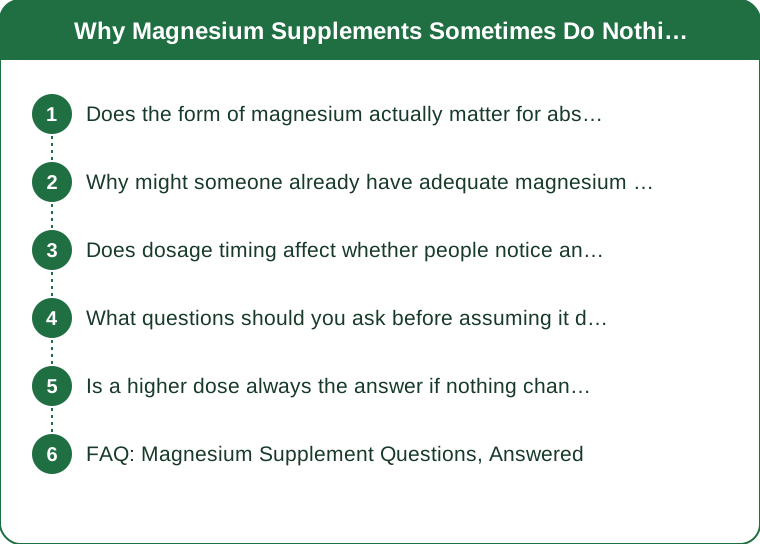
Does the form of magnesium actually matter for absorption?
Yes — forms like magnesium oxide are poorly absorbed compared to magnesium glycinate, citrate, or malate, so someone taking a cheaper, less bioavailable form may be getting only a small fraction of the labeled dose actually absorbed.
Why might someone already have adequate magnesium levels?
A varied diet rich in leafy greens, nuts, and whole grains can already provide sufficient magnesium for many people, meaning supplementation adds little noticeable benefit if there was no real deficiency to begin with.
Does dosage timing affect whether people notice an effect?
Some effects, like support for sleep quality, are more noticeable when taken an hour or two before bed rather than with a morning meal, so timing mismatched to the intended benefit can make a supplement seem ineffective.

What questions should you ask before assuming it does not work?
How would you actually know if you were deficient beforehand?
A blood test can indicate magnesium status, though standard serum tests capture only a small fraction of the body’s total magnesium, so symptoms like cramping or poor sleep are also relevant clues alongside testing.
Could an underlying condition be affecting absorption?
Digestive conditions affecting nutrient absorption, certain medications, and high alcohol intake can all reduce how much magnesium the body actually retains from either food or supplements.
Is a higher dose always the answer if nothing changes?
Not necessarily — very high doses mainly increase the risk of digestive side effects like loose stools without proportionally increasing absorbed magnesium, since the body limits how much it absorbs at once regardless of intake amount.
FAQ: Magnesium Supplement Questions, Answered
Which magnesium form is generally best absorbed?
Magnesium glycinate and citrate are generally considered more bioavailable than magnesium oxide, which is one of the most common but least well-absorbed forms sold.
How long should you try a supplement before deciding it does not work?
Most people give it 3-4 weeks of consistent use, since some benefits like improved sleep quality build gradually rather than appearing immediately.
Should you talk to a doctor before starting magnesium?
It is worth checking, especially if you take other medications or have kidney issues, since magnesium can interact with certain drugs and isn’t cleared as efficiently with reduced kidney function. This is general information, not medical advice.
TL;DR:
- Poorly absorbed forms like magnesium oxide often explain a lack of noticeable effect
- Already-adequate dietary magnesium levels mean supplementation adds little extra benefit
- Timing matters for some benefits, particularly sleep-related effects
- Higher doses mainly risk side effects rather than guaranteeing better absorption
A magnesium supplement that seems to do nothing usually has a specific, identifiable reason rather than the nutrient itself being ineffective.
Keep Reading
This article is for general informational purposes only and is not medical advice. Always consult a qualified health professional for guidance specific to you.