Why Magnesium Seems to Work in Days for Some People and Weeks for Others
Quick Answer: Baseline magnesium deficiency level, the specific magnesium form used, dosage, and how consistently it’s taken all affect how quickly effects show up — someone with a significant existing deficiency taking a well-absorbed form consistently often notices changes faster than someone with only mild depletion on an inconsistent routine.
It’s easy to assume magnesium ‘isn’t working’ if a friend felt a difference in days and you’re still waiting after two weeks. The gap usually comes down to a few specific, identifiable variables rather than random individual variation.

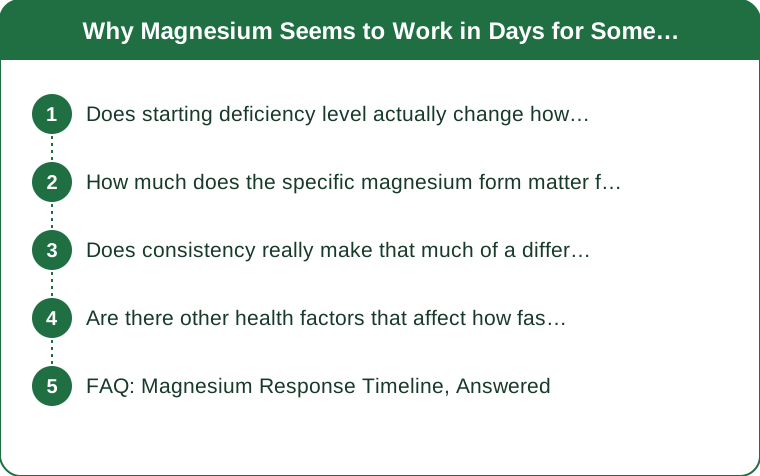
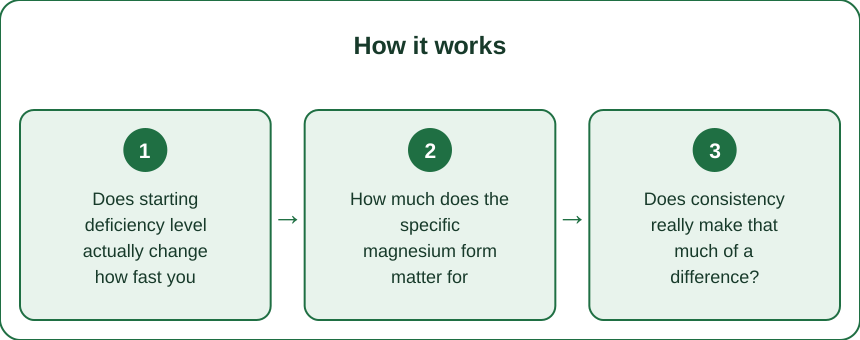
Does starting deficiency level actually change how fast you notice effects?
Yes, significantly. Someone starting from a more pronounced magnesium deficiency often notices sleep or muscle-related improvements faster, simply because there’s a bigger gap between their baseline and adequate levels for supplementation to close. Someone with only mild, marginal depletion has a smaller gap to close, which can make the change feel more gradual and harder to notice day to day.
How much does the specific magnesium form matter for timeline?
Quite a bit — forms like magnesium glycinate or citrate are generally better absorbed than magnesium oxide, which has notably lower bioavailability despite being common in budget supplements. Someone taking a poorly absorbed form may need a higher dose or more time to reach the same tissue magnesium levels as someone on a well-absorbed form at a standard dose.

Does consistency really make that much of a difference?
Yes — magnesium works by gradually replenishing tissue stores, not through an acute, single-dose effect for most of its benefits (sleep, muscle relaxation, mood). Inconsistent daily use resets that gradual replenishment process repeatedly, which is a common, underrated reason someone feels like ‘it’s not working’ after weeks of on-and-off use.
Are there other health factors that affect how fast magnesium ‘works’?
Yes — conditions and habits that increase magnesium excretion or reduce absorption (high alcohol intake, certain medications, high-stress states that increase magnesium turnover, digestive conditions affecting absorption) can all slow the apparent timeline, since the body is losing or failing to absorb magnesium faster than a baseline healthy state would.
FAQ: Magnesium Response Timeline, Answered
How long should I wait before assuming magnesium ‘isn’t working’ for me?
Most guidance suggests giving a consistent daily routine at least 4-6 weeks before judging effectiveness, since tissue magnesium replenishment is a gradual process for most people.
Should I switch forms if I don’t notice anything after a few weeks?
It’s a reasonable next step — if you started with magnesium oxide or another lower-bioavailability form, switching to glycinate or citrate and reassessing after another few weeks is a common and often effective adjustment.
Could something else be preventing magnesium from working for me?
Possibly — if consistent use of a well-absorbed form for 6+ weeks still shows no change, it’s worth discussing with a doctor, since absorption issues, medication interactions, or an unrelated cause for the original symptoms could be involved.
TL;DR:
- Starting deficiency level is a major factor — bigger gaps to close often show faster noticeable change
- Magnesium form matters: glycinate and citrate absorb better than oxide
- Consistency matters more than people expect — on-and-off use resets gradual tissue replenishment
- Give a consistent routine 4-6 weeks before concluding it isn’t working
This is general information, not medical advice — talk to a doctor if you’re taking medications, since magnesium can interact with several common ones.
Keep Reading
This article is for general informational purposes only and is not medical advice. Always consult a qualified health professional for guidance specific to you.